Examples of authentic learning in Internet Communications III: NET204

See also other posts including the first one, on Web Communications 101, which explains more of the context. Internet Communities and Social Networks 204 (basic unit description) One of the most authentic learning experiences we try to offer students in the BA (Internet Communications) is the network conference, the focal point and driving force for the unit NET204. In this unit, the whole learning journey is designed around a 3-week online asynchronous conference in the latter stages of the study period: the first part of the unit involves writing the conference paper, improving it after feedback, and also designing and discussing how to run the conference and promote it. Because every element of the unit is designed ‘around’ the conference, this unit is more than just an authentic assessment task: rather, it is an authentic learning experience, with the assessment almost ‘blending’ in with that experience. For example – the ‘conference paper’ is submitted, assistance given and then students can improve it, rather than in traditional approaches simply being done and marked. Very few activities in the real world involve submission of intellectual work that can’t be improved once completed. The conference ran first in 2010 and can be viewed … Click to read more

Portfolios, digital and reflection: interleaving Michael Dyson

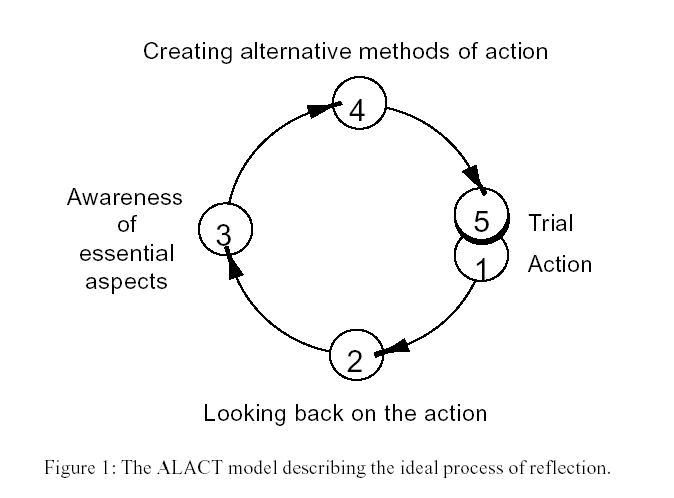
Listening to Michael Dyson, from Monash talking about portfolios in teacher education: great presentation. Dyson says: Education of educators is first of all premised on turning them into people who practice self-development. gives example of very first unit. [So, care of the self is central, and making students include themselves as subjects in the learning process - nice!] Learning is change dramatically – globalisation, computing, and so on. [But, perhaps, there is an important qualification on some of the more optimistic claims for 'new' learning: learning is embedded within society in ways that shape those possibilities in ways that are not entirely concerned with 'better' learning. At the very least, the definition of better is contested: is it cheaper? is it more orderly and commodifiable? is to linked to national norms and needs?] The creating mind is the goal. [Interesting - not creative, but more positive and active - creating. Good difference] Reflection is essential to achieving the kind of succcesses in self-developmental learning; using Dewey (2003), emphasises “active persistent and careful consideration”; reflection is not taking “things for granted…[leading to] ethical judgment and strategic actions” (Groundwater-Smith, 2003).  [ Further work needed, perhaps, to understand reflection for this new generation, … Click to read more

Examples of authentic learning in Internet Communications II: WEB206

See also other posts including the first one, on Web Communications 101, which explains more of the context. Web Publishing 206 (basic unit description) Students doing the BA (Internet Communications) learn, in WEB101, to create a web presence that acts as the primary locus of their online identity, with links to other services and applications. In Web Publishing 206, the focus moves much more directly to writing effectively for the web (where writing can also including other media, but emphasises the written word). The authenticity of the assessments in Web Publishing 206 are principally mobilised by requiring students to write regularly, on their blog, exploring different aspects and techniques of good online writing. The blog is assessed in its own terms, and also as the basis for students’ reflective essays which ensure that students are thinking about (as well as doing) this crucial online communication task. Some examples of students’ blogs are: Eighteen Songs – WEB206 Weekly Blog Percussive Sweet Spot On the Internet, No-one Knows I’m A Blog Damien’s Web Publishing 206 Weblog | The Worlds of MMO’s Notably, most students make virtually no reference to the ‘study’ component of these blogs: these are genuine blogs addressing audiences outside … Click to read more

Examples of authentic learning in Internet Communications I: WEB101

The first of several posts, each relating to a different unit of study at Curtin Introduction Over the past two years, students in Internet Studies, Curtin University studying the BA (Internet Communications) and related courses have been doing a lot of authentic assessment involving online activities. These assignments are  authentic in that they are ‘true’ to the content of their studies (that is, aligned with the outcomes), ‘ real’ within the likely fields of employment for graduates, and ‘natural’  for the the emerging dominance of knowledge networking in society. More on these three variations on authenticity in a moment. Not all assessments fit this pattern (nor should they), but we have seen significant improvements in the motivation of students to complete and exceed the requirements of assignments, as well as a greater degree of creativity and expression suggesting deeper engagement with learning. It has also, we think, improved students’ attention to more scholarly traditional assignments (such as essays) because of the variety we engendered across all assignment tasks. (And, it should be noted: essays are authentic – to the lifeworld of academic which also remains important as well as work and elsewhere). Much of what makes these assessment approaches authentic … Click to read more

Authentic learning: presentation to NCIQF

On Thursday 2 December, I am presenting at the National Curriculum Innovation and Quality Forum on the subject, “Risks and opportunities in authentic learning via the Internet”. The basic brief for this keynote presentation is to: summarise approaches to authentic learning in the BA (Internet Communications) at Curtin University; identify the key benefits in using a public knowledge networking approach to authentic learning; and highlight risks and strategies for managing those approaches in the pursuit of authentic learning online. While I hope to do that, with a particular emphasis on giving some examples from the great work that students in the BA (Internet Communications) have done, I also have found that in preparing my talk I have had to develop a more coherent argument about the nature of authenticity in learning and the relationship between education and learning. The talk can be found here: http://netcrit.net/content/nciqf2010.pdf Slides are here: http://www.slideshare.net/netcrit/risks-and-opportunities-in-authentic-learning-via-the-internet This paper draws also on some specific work I have done on the authentic assessment in our online conference unit, Internet Communities and Social Networks 204 (slides here) and more generally on social media and authentic assessment (presentation in the UK, May 2010 here) Some of the examples I refer to … Click to read more

Risks and Opportunities in Authentic Learning via the Internet

In late 2010, I am presenting a keynote paper at the The National Curriculum Innovation and Quality Forum 2010, in Melbourne. I will be speaking on the use of the Internet to promote authentic learning. In the paper I summarise approaches to authentic learning in the BA (Internet Communications) at Curtin University, identify the key benefits in using a public knowledge networking approach to authentic learning; and highlight risks and strategies for managing those approaches in the pursuit of authentic learning online. Slides and full text are available. Click to read more

Authentic Assessment in the era of Social Media: ideas and applications from Internet Communications

While visting the UK, I will present a detailed account of the way social media, Web 2.0 and the read/write web cab be understood for higher education in terms of authentic assessment. Crucially, I am trying to show, by examples from the Internet Communications course at Curtin, how the use of Web 2.0 in blended and online learning can more generally be based on real-world knowledge production, in knowledge networks, that bridge the growing gap between formal and informal learning via the Internet. Slides with notes available. Click to read more

Authentic Assessment and the Internet

Authentic assessment is crucial to effective use of online learning; in this paper I advance some arguments as to the complexity of the term ‘authentic’ noting that it can mean a lot more than just ‘aligned’ with curriculum and relevant to the ‘real world’. Click to read more